Stopping Spec Drift in the Era of Fast AI Coding: Building an OSS Called jev-spec
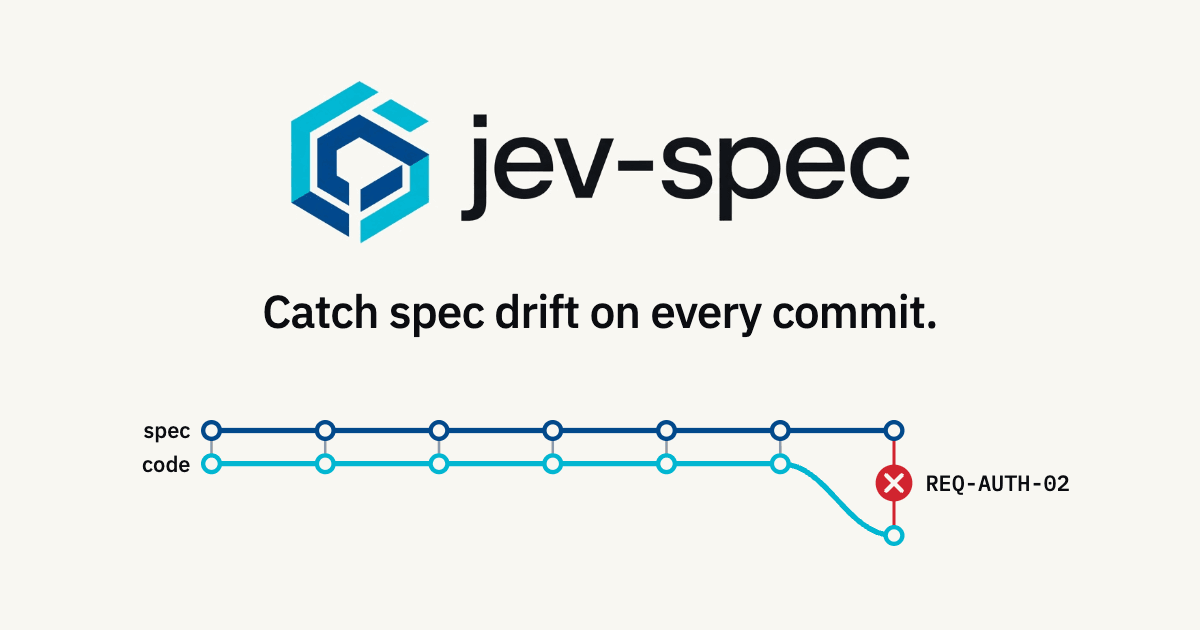
The Reality of Fast AI Coding and Spec Drift
Section titled “The Reality of Fast AI Coding and Spec Drift”About six months ago, I wrote an article about contextlint, a linter that statically analyzes the consistency of Markdown documents.
In Specification-Driven Development (SDD), teams translate business “requirements” into system behaviors as “specifications (acceptance criteria)”, and further flesh them out into “designs” such as table schemas and screen layouts, capturing them in Markdown and feeding them into AI coding agents like Cursor or Claude Code.
AI writes code at breathtaking speed. However, as the velocity of code generation increases, the frequency with which human developers reread original specifications drops proportionally. In day-to-day code reviews, attention naturally gravitates toward immediate diffs and runtime smoke tests. Reviewing whether every sentence in the specification still holds against the generated code’s behavior is rarely feasible. As a result, discrepancies between specifications and code accumulate unnoticed beneath the surface.
Static analysis (contextlint and similar tools) can confirm that a specification contains an entry such as REQ-AUTH-02 (used here as an example of a requirement or specification identifier), follows the expected format, and is properly referenced across documents. But whether src/auth/session.ts still behaves according to REQ-AUTH-02 cannot be verified by parsing document syntax alone.
To counter this drift, some teams create custom slash commands or Agent Skills in Cursor or Claude Code to periodically crawl the codebase and check alignment against specifications. In practice, this means asking an agent: “Check whether this code satisfies all requirements in the spec and flag any omissions.”
Yet running this approach on every commit is impractical. Stuffing substantial codebases and full specifications into prompts and running general-purpose LLM agents takes minutes per run and consumes significant token costs. It is far too slow and expensive to act as a pre-commit hook gating git commit. Consequently, drift detection remains an occasional, heavy audit run only when someone remembers, while discrepancies between specifications and code continue to accumulate unnoticed during daily development.
“Could we catch the drift between specifications and code in tenths of a second on every single commit?” This question led me to develop the OSS jev-spec.
The Limits of Traditional LLMs and the Arrival of Jev
Section titled “The Limits of Traditional LLMs and the Arrival of Jev”When attempting to build a pre-commit gate that reconciles code against specifications, traditional LLMs face structural bottlenecks.
General-purpose LLMs are fundamentally autoregressive: they choose the next token conditioned on tokens already produced. JSON mode and Structured Outputs still sample the output as a token sequence that fits the schema. The schema only constrains which tokens are legal next. It does not change the generation method. Longer output increases wait time and output-token cost. Wait time also includes input processing, reasoning-token generation, and the first schema compilation. Billing is not limited to output tokens. Input tokens are charged separately. To avoid breaking a developer’s flow during a local pre-commit check, verification must finish in under a second. High latency and recurrent token billing make traditional LLMs ill-suited for every commit.
A fresh architectural direction arrived with Jev, a model developed by TypeSafe AI. TypeSafe categorizes Jev as a “System One model.”
To describe it accurately: Jev does not perform free-form autoregressive text generation or sequential token decoding. Instead, it directly evaluates given context or state (text, data, application state, and similar inputs) in a single pass and outputs typed decision primitives: well-calibrated probabilities and scores. jev-spec uses this capability by passing specifications and code as context and reading probabilities for each spec item’s Rubric.
Because it does not generate text token by token, there is no waiting on output decoding, and output tokens are free. Input token costs are negligible ($0.042 per million input tokens), and response times clock in at just 70 to 400ms.
Jev provides three core decision primitives:
-
noul(Boolean proposition)evaluates a proposition answerable with yes or no, returning a probability between 0 and 1
-
choice(Categorical distribution)evaluates a discrete probability distribution across declared, mutually exclusive options (such as
compliant,vulnerable, orinconclusive) -
score(Ordinal rubric)evaluates an ordered rubric (such as a multi-tier maturity scale from stub to production-grade), returning an expected score and level probabilities
Because Jev’s output is numeric and grounded from the start, there is no need to parse natural language. Comparing the returned probability against a deterministic threshold (such as minProbability: 0.85) produces an immediate pass or fail verdict.
Expanding Horizons: Jev’s Broader Potential and the Genesis of jev-spec
Section titled “Expanding Horizons: Jev’s Broader Potential and the Genesis of jev-spec”It is worth emphasizing that Jev was not designed exclusively for specification verification.
Observing the developer community on X, engineers are leveraging this ultra-fast, low-cost decision primitive to build software interactions that were previously unviable.
Marcus Lowe’s smart clipboard demo instantly evaluates copied text, recognizes whether it contains contact details or personal credentials, and routes the content to corresponding form fields in milliseconds. OkinaAudio’s creative audio workflow for Ableton demonstrates fast audio and UI interaction.
Unlike open-ended text generation models, executing fast, inexpensive, type-safe decisions in milliseconds opens up distinct possibilities for software interaction. As an engineer, watching this architectural direction unfold is genuinely exciting.
Seeing Jev’s characteristics firsthand sparked an immediate question from my background building contextlint:
“If we have a decision primitive this fast and lightweight, could we verify whether code satisfies the behavior and requirements written in specifications on every single git commit?”
Exploring whether this fast decision model could be applied to Specification-Driven Development is what motivated me to start building jev-spec.
How jev-spec Works
Section titled “How jev-spec Works”The operational pipeline in jev-spec consists of four steps:
-
Read the spec
extracts the statements to verify from a Markdown specification based on sections, headings, or specification/requirement IDs
-
Read the code
loads the source files implementing that specification
-
Evaluate rubrics
submits focused evaluation questions (Rubrics) per spec item to Jev, which evaluates the spec and code as context in a single pass and returns probabilities in parallel
-
Compare
evaluates the probabilities against defined threshold assertions, stopping the build as a validation error (check failure) if any assertion fails
Each evaluation question is called a Rubric, and the comparison with a threshold is an Assertion. While binary verification with noul is most common for specs, the DSL also supports choice and score.
For speed and rigorous type safety, jev-spec adopts TypeScript 7, powered by the new Go compiler. Furthermore, it provides official dual runtime support for both Node.js (22+) and Bun.
Basic Usage
Section titled “Basic Usage”Getting started with jev-spec in your project is straightforward.
Agent Skills clients (Claude Code, Cursor, Codex, Antigravity CLI, and GitHub Copilot) can install a skill with the following command:
gh skill install nozomi-koborinai/jev-spec <skill-name>| Skill | Role |
|---|---|
jev-spec-init | Maps the spec to the code and drafts the Rubrics |
jev-spec-fix | Helps fix a failed check |
1. Installation
Section titled “1. Installation”Add jev-spec to your devDependencies using your package manager of choice:
npm install -D jev-spec# orbun add -d jev-spec2. Configuration (jev.config.ts)
Section titled “2. Configuration (jev.config.ts)”Create a jev.config.ts file in your project root and declare the mapping between specifications and code in targets:
import { defineConfig, noul } from 'jev-spec';
export default defineConfig({  client: { model: 'jev-1.13.0' },  targets: {    auth: {      specPath: 'docs/specs/auth-requirements.md',      codePaths: ['src/auth/**/*.ts', '!src/auth/**/*.test.ts'],      rubrics: {        'REQ-AUTH-01': noul(          'Is the signature of a session token checked before access to a protected resource is granted?'        ),        'REQ-AUTH-02': noul('Is a token rejected when its ID is on the revocation list?'),      },      assertions: {        'REQ-AUTH-01': { minProbability: 0.85 },        'REQ-AUTH-02': { minProbability: 0.85 },      },    },  },});
Key options configured in defineConfig include:
-
specPathpath to the target Markdown specification file
-
codePathsglob patterns for code files implementing that specification (with negation support to exclude test files)
-
rubricsspec and behavior checks written as natural-language questions using
noul(...)(keyed by IDs such asREQ-AUTH-01or target spec item names)Note: Keying by IDs is merely one example. Even if your project does not strictly assign requirement IDs, you can organize rubrics with arbitrary key names.
-
assertionsminimum confidence threshold for passing (such as
minProbability: 0.85)
3. Setting the API Key
Section titled “3. Setting the API Key”Export your TypeSafe AI API key as an environment variable:
export TYPESAFE_AI_API_KEY="your-api-key"4. Running Checks
Section titled “4. Running Checks”Once configured, run checks from the CLI.
To verify all targets across the entire repository:
npx jev-spec check# orbunx jev-spec checkTo verify only targets affected by staged Git changes before committing, use the --staged flag. Targets unaffected by the staged diff are automatically SKIPPED:
npx jev-spec check --stagedThe CLI report prints clear, structured feedback:
$ npx jev-spec check
=== jev-spec Check Report ===
Target: auth [✖ FAILED]  Spec files: docs/specs/auth-requirements.md  Code files: src/auth/session.ts  Model: jev-1.13.0    ✔ REQ-AUTH-01: probability: 0.97    ✖ REQ-AUTH-02: probability: 0.08       └─ Violation: Probability 0.08 is below minimum threshold 0.85
Overall: ✖ CHECKS FAILED
$ echo $?1
Displaying comparison results between probabilities and thresholds per spec item (ID) makes it straightforward to identify exactly which specification and code have drifted.
5. Workflow Integration
Section titled “5. Workflow Integration”jev-spec shines most when embedded into your routine development workflow as an everyday gate:
-
Staged checks in pre-commit hooks
using tools like husky or simple-git-hooks, run
npx jev-spec check --stagedon every commit. Because it evaluates only modified targets in milliseconds, it catches drift before code is committed without interrupting your flow -
Full checks in CI
in your CI pipeline (such as GitHub Actions), run a full
npx jev-spec checkacross all targets to guarantee spec compliance before merging pull requests
What Real-World Measurements Revealed
Section titled “What Real-World Measurements Revealed”Gating builds on a probabilistic model raised questions about cost and reproducibility. To investigate, I conducted empirical measurements on jev-spec’s own repository, which maintains its own specs (docs/specs/). The numbers below were recorded on September 21, 2026 using jev-1.13.0.
Measured Cost
Section titled “Measured Cost”Checking all 8 targets and 22 Rubrics across the entire repository completed in approximately 4 seconds. Individual targets took between 0.3 and 0.9 seconds. CLI startup alone took roughly 0.1 seconds on Node.js (and was even faster on Bun); the vast majority of runtime was spent on network requests.
The estimated cost reported by the CLI was approximately $0.0006 per full run. Rather than stuffing the entire codebase into context, jev-spec transmits only the relevant spec excerpt and a handful of files per target. Jev evaluates all Rubrics in that target in a single pass. The cost of running this on every commit is negligible.
Reproducibility and Model Pinning
Section titled “Reproducibility and Model Pinning”Repeating identical Rubrics over identical code five times yielded a confidence variance of 0.00 to 0.03 on clean code. A probability moving from 0.96 to 0.95 remains safely above the example threshold of 0.85 (configured as minProbability in the settings).
Thresholds are not hardcoded values; they can be configured individually in the settings based on the nature of the specifications and requirements. In addition, because aliases such as latest can resolve to a newer model version and cause unintended shifts in evaluations, specifying an explicit versioned ID (such as jev-1.13.0) in client.model is recommended. Pinning the model ensures consistent evaluations over time and prevents unexpected behavioral changes, with the report explicitly displaying the model ID used.
Static Analysis vs. Decision Models, and Conclusion
Section titled “Static Analysis vs. Decision Models, and Conclusion”Deploying jev-spec effectively requires recognizing its operational boundaries:
-
A check, not a mathematical proof
passing indicates a probability surpassed an empirical threshold, not formal correctness. Internal terminology deliberately uses “check” rather than “verify”
-
English is officially recommended
while official documentation recommends English and notes that CJK languages may not reach the same accuracy, in practice Jev also understands Japanese specifications and Rubrics quite well and can evaluate them effectively
-
Adversarial code comments can bias evaluations
comments stating “this function satisfies the specification” can skew decisions. TypeSafe lists this as a known model limitation
-
Arithmetic, dates, and multi-step reasoning are poor fits
counting items or comparing calendar dates should be verified via standard unit tests rather than Rubrics
The complementary roles of contextlint and jev-spec can be summarized as follows:
| Dimension | contextlint | jev-spec |
|---|---|---|
| Scope | Consistency across documents | Alignment between specs and code |
| Method | Rule-based static analysis | Model Rubric evaluation and threshold comparison |
| Determinism | Deterministic | Probabilistic |
| AI Dependency | None | Yes (TypeSafe AI Jev) |
In an era where AI generates code at unprecedented speed, guarding against specification drift without slowing down development rhythm is essential.
jev-spec started as a personal experiment, but if you maintain specifications in Markdown and worry about drift from code, consider giving it a try.